
The Most Dangerous Part of Your Journey May Begin After You Return
A journey may end when the aircraft lands, but some risks can emerge days or even weeks later. Through a real-life story, a recent travel-related case and practical Travel Security experience, this article explores the importance of health awareness, risk recognition and post-travel vigilance for both individual travellers and organisations.
TRAVEL RISK MANAGEMENTDUTY OF CARETRAVEL RISKTRAVEL SECURITYTRAVEL HEALTBUSINESS TRAVELINTERNATIONAL TRAVEL RISK
Danilo Amelotti
6/3/20269 min read

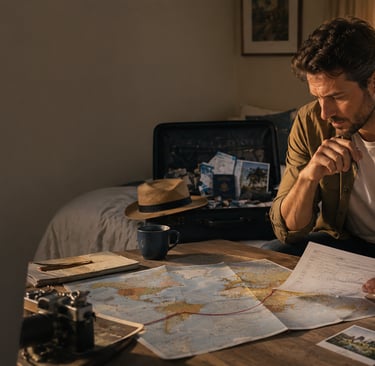
When the Holiday Is Already Over
This could be anyone's story.
The kind of story that begins when the holiday is over, when you glance at the clock with that familiar mix of resignation and frustration because the time away passed far too quickly and tomorrow life returns to normal. Work, commitments, unanswered emails, missed phone calls and all those things that, only a few days earlier, seemed incredibly distant while you were sitting on a beach, wandering through a city you had always wanted to visit or simply enjoying the rare luxury of having nowhere important to be.
I imagine that, for many of the people involved in the story I am about to tell, what eventually happened would have seemed completely unrealistic. In fact, they would probably have looked at anyone suggesting that a Travel Security course could have value for an ordinary holidaymaker with a fair amount of scepticism.
After all, when people hear the term Travel Security, their minds usually go elsewhere. They think about kidnappings, terrorism, civil unrest, armed conflict, violent crime, political instability or the sort of dramatic scenarios that have filled news reports, films and corporate briefings for decades.
Certainly not a beach holiday.
The suitcases were probably already stored away in a loft, garage or spare room. The photographs had been shared. Friends had asked how the trip had gone, and the answers were probably the same answers we all give: the weather was fantastic, the hotel was excellent, the food was memorable, that particular excursion was worth the entire trip or perhaps there was a sunset so beautiful that no photograph quite managed to capture it.
In other words, all the things that normally happen when we return from two weeks in one of those destinations that constantly appear in online advertisements, glossy resort brochures and social media feeds, where every image seems designed to suggest that somewhere out there a perfect holiday really does exist.
That is why a video I watched yesterday on Facebook caught my attention far more than it probably would have caught the attention of most people.
It concerned several British tourists who had returned from a holiday in Cape Verde. Some had developed gastrointestinal symptoms during their stay, others after returning home. Several later died. Investigations are still ongoing and it is certainly not the purpose of this article to speculate about responsibility or draw conclusions that belong to others. Preliminary findings from local authorities identified traces of Shigella contamination in water used to wash food, but to be honest, that was not what caught my attention most.
Something else did.
Initially, nobody appeared to connect those deaths to that particular holiday, at least not until it became apparent that these were not isolated cases but several people linked by one seemingly minor detail: they had all been in the same place during the same period of time.
And that led me to a very simple question.
If those deaths had occurred months apart rather than close together, would anyone ever have connected them to that holiday? Or would they simply have been recorded as separate, unrelated events with no obvious link between them?
After all, those people had already returned home.
The holiday was over, normal life had resumed and, in our minds, when something ends, we tend to close the entire chapter that surrounds it. I can almost hear the familiar responses: "Surely not..." or "That can't be related..."
And yet that is precisely where one of the most interesting lessons of this story lies.
When we think about travel, we usually see it as something with a clearly defined beginning and end. There is the preparation, there is the journey itself and then there is the return home. Once we walk back through our own front door, everything connected to that experience slowly gets filed away into memory.
The photographs remain. The good memories remain. The laughter remains, along with the phone numbers of those strangers we met and somehow ended up talking to for hours. Perhaps there is even a souvenir purchased in an airport shop at the last minute.
But in our minds, the journey is over.
And yet, every now and then, reality reminds us that things do not always work that way.
When the Journey Continues Without Us
That question stayed with me for the rest of the day.
Not because of Cape Verde, not because of Shigella and not because of the investigation itself, but for a much simpler reason. I was looking at the same mental mechanism that I have encountered countless times throughout my professional life and that I discuss in every course I teach.
It is the mechanism that leads us to dismiss a possibility not because it is impossible, but simply because it no longer feels relevant.
And that is when I found myself thinking about a much older story.
One that, if I am honest, I had probably filed away in exactly the same mental drawer where we place everything we consider part of the past.
Many years ago, a colleague of mine from the Italian Army Special Forces returned from a deployment in Rwanda. Conditions during that mission were extremely demanding, involving humanitarian operations, evacuations and an environment where health risks were every bit as real as operational ones.
After returning to Italy, he began to feel unwell.
That was the first time I witnessed, first-hand, a lesson that every traveller should learn, but we will come back to that shortly.
At first it appeared to be influenza, or at least that was what he had convinced himself it was. In reality, it was malaria, and an aggressive form at that. He died only a few days later.
The most interesting part of that story is not the malaria itself.
Nor is it the fact that it had been contracted in Africa.
The most interesting part is that several people advised him to seek medical attention, yet he remained convinced that he was simply dealing with flu.
And that highlights another mechanism that people consistently underestimate.
When an explanation appears sufficiently plausible, we tend to cling to it. Not because we are careless or incapable, but because the human mind almost always prefers explanations that are familiar, comfortable and easy to understand.
Knowledge Is Not Fear
Some readers may assume that stories like this, or the story from Cape Verde, are intended to create anxiety.
The reality is exactly the opposite.
After more than thirty years spent working in security, training and complex environments, I have learned that fear is usually born from ignorance, while awareness is born from information. And if informing people occasionally requires telling stories that ended badly, then it is worth doing, because some of the most valuable lessons come from precisely those stories.
Looking back, I believe that experience taught me something far more important than malaria or Rwanda.
It taught me that there is a significant difference between knowing about a risk and recognising it when it appears.
Before travelling, particularly to destinations with environmental, health or climatic conditions that differ from those we are accustomed to, there is no need to become a researcher, epidemiologist or tropical medicine specialist. Nobody expects a tourist or a business traveller to spend weeks studying every possible disease present in the country they are visiting.
The objective is far simpler and far more practical.
Travellers should understand the most relevant health risks associated with their destination, how those risks typically present themselves and what symptoms may appear during or after the trip. Not to create anxiety. Not to turn every headache into a medical emergency. Simply to establish a mental reference point should something unexpected occur.
In other words, you do not need to know everything.
You simply need to know what to look for.
The Practice Almost Nobody Applies
If I am travelling to an area where malaria exists, understanding that fever, chills, fatigue or flu-like symptoms may deserve attention does not make me more vulnerable.
It makes me better prepared.
Likewise, if a destination presents known issues relating to water quality, food hygiene or gastrointestinal infections, understanding the common warning signs is not about fear. It is about being able to interpret events correctly should they arise later.
And this leads to a simple practice that is rarely taught and even more rarely applied.
When a journey ends, it should not immediately disappear from our operational memory.
If symptoms appear, if concerns arise or if we find ourselves sitting in front of a doctor, one of the first pieces of information we should provide is often the very thing we forget to mention:
Where we have been.
It sounds obvious.
Very often it is not.
For a doctor, knowing that a patient has recently returned from Scandinavia or Central Africa can completely change how identical symptoms are interpreted.
What appears to us as nothing more than fatigue, fever or an upset stomach may take on an entirely different meaning when placed within the correct geographical and temporal context.
The Most Dangerous Risk Is the One We Stop Seeing
And that is probably the common thread connecting the story from Cape Verde, the story of my colleague and countless other cases.
The issue is not necessarily the nature of the threat itself.
The issue is the mental process that encourages us to minimise or entirely dismiss risks simply because they no longer fit the story we are telling ourselves.
When a journey ends, everything associated with that journey tends to end with it. If a fever appears several weeks later, we think of influenza. If gastrointestinal problems develop, we think of a stomach bug. If we feel exhausted, we blame stress, work, seasonal changes or simply getting older.
All of those explanations are perfectly plausible.
And that is precisely what makes them dangerous.
If someone returning from Rwanda immediately suggested malaria, many people would consider that an overreaction. If a holidaymaker returning from a beach resort blamed food contamination for every minor illness, most of us would probably think they were exaggerating.
And yet that is the paradox.
Incorrect explanations are rarely absurd.
Most of the time they are entirely believable.
And it is their credibility that makes them dangerous.
Perhaps that is also why many people spend more time choosing the perfect suitcase than understanding the most likely health risks associated with their destination.
Not because they are irresponsible.
Simply because the human mind naturally assigns greater importance to threats it can easily visualise.
Beyond Terrorism and Crime
A terrorist, a criminal or political instability in a hostile region are easy to imagine.
Food contamination, a mosquito or a microscopic pathogen inside a beautiful holiday destination are not.
And yet, as Merlin and Madam Mim reminded us many years ago in a classic Disney story, the most troublesome enemy is not always the largest one.
Sometimes it is the smallest.
So small that it cannot be seen at all.
Which is perhaps why Travel Security, so often associated exclusively with terrorism, crime and hostile environments, should be understood for what it truly is:
Risk management.
The Responsibility of Organisations
For organisations, this discussion becomes even more important.
When a company sends employees overseas, its responsibility does not end with booking flights, arranging insurance or providing an emergency contact number. Preparing people to understand the environment in which they will operate also means helping them recognise less obvious but often far more likely risks, while ensuring they understand what checks and precautions should be considered both before and after travel.
This is where the difference emerges between genuine preparation and the sort of training that exists merely to tick a compliance box.
Good training is not designed to turn people into doctors, epidemiologists, tropical disease specialists or security experts. It is designed to do something far simpler and far more useful: change the way we observe reality. It teaches us which questions to ask before departure, which information is worth retaining during a journey and which details should never be ignored after returning home. Whether the issue involves personal security, hotel security, destination assessment, health concerns or an unexpected incident, the principle remains exactly the same:
You do not need to know everything.
You need to know what to look for.
When We Think the Story Is Over
Ultimately, the lesson that emerges from both Cape Verde and the story of my colleague is surprisingly simple.
A journey does not necessarily end when the aircraft lands.
Sometimes the most important part of the story begins precisely when we believe it is already over.
Sources and Further Reading
World Health Organization (WHO) – Travel and Health
International health guidance, travel-related disease information, vaccination recommendations and global public health updates.CDC Travelers' Health (Centers for Disease Control and Prevention)
Country-specific health advisories, vaccination guidance, travel notices and practical health recommendations for international travellers.European Centre for Disease Prevention and Control (ECDC)
European monitoring and reporting of infectious diseases, outbreaks and emerging public health threats.NHS Fit for Travel
Practical destination-specific travel health information, vaccination guidance and traveller advice.
Disclaimer
None of the sources above should be used to create anxiety or turn a holiday, business trip or overseas assignment into an exercise in paranoia.
Their purpose is far simpler.
They help travellers understand the environment in which they will operate, recognise potential risks more quickly and provide useful context to healthcare professionals should medical issues arise during or after travel.
The objective is not fear.
The objective is awareness.
As with every aspect of Travel Security, success rarely depends on knowing everything. More often, it depends on recognising the right signals while there is still time to act on them.