
Terrorism Is Not Dead. It Is Adapting.
This article does not argue that emerging technologies will inevitably be adopted by terrorist organisations. Rather, it explores how historical patterns of adaptation, radicalisation and technological diffusion may shape future security challenges. From organised terrorist networks to lone actors, from online radicalisation to autonomous systems and drone-enabled capabilities, this analysis examines how asymmetric threats continue to evolve and why understanding these trajectories remains essential for effective prevention.
TERRORISMSECURITYEMERGING THREATSTECHNOLOGYSECURITY ANALYSIS
Danilo Amelotti
6/20/202610 min read
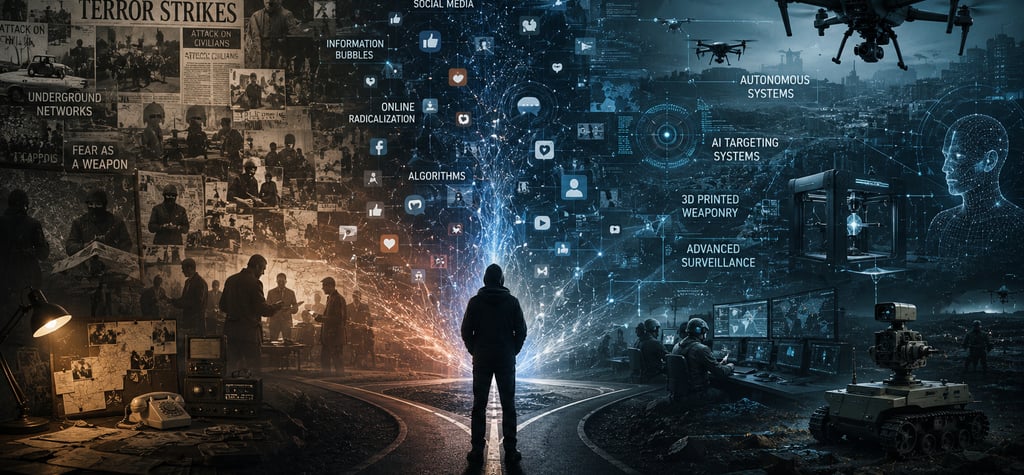
How radicalisation, technology and operational capabilities are reshaping asymmetric warfare
Terrorism as a Form of Adaptation
When people think about terrorism, they usually think about organisations. Al-Qaeda. ISIS. The Red Brigades. The IRA. Names, symbols, leaders and ideologies that dominated newspaper headlines for years and eventually became synonymous with terrorism itself in the public imagination. Yet, when viewed through a broader lens, a different reality emerges. Organisations are born, grow, transform and often disappear. Terrorism, however, persists.
This is because terrorism is not, first and foremost, an organisation. At its core, it is a form of asymmetric warfare. It is a method employed by those who lack the ability to confront a stronger opponent directly and therefore seek to achieve a psychological, social or political effect that is disproportionate to the resources invested. Terrorism has never been primarily about conquering territory or destroying armies. Its true objective has always been to influence the behaviour of people, governments and societies.
For much of modern history, achieving that objective required complex structures. It required personnel, funding, logistics, forged documents, training, safe havens, communication channels and clandestine networks capable of supporting every stage of planning and execution. Even suicide attacks, which are often perceived as relatively simple operations, demanded a significant organisational effort. Building an explosive device was only one part of the process. Organisations also had to identify individuals willing to sacrifice their lives, radicalise them, train them, protect them throughout the process and ultimately guide them to their target.
Behind the attacks that shaped Western collective memory—from 9/11 to Madrid, from London to the Bataclan—stood organisations capable of transforming resources, planning and coordination into operational capability.
Over the last two decades, however, we have witnessed a significant shift in both the modus operandi and the broader strategy of terrorism.
Terrorist organisations have not disappeared, and it would be naïve to suggest otherwise. Yet they no longer operate with the same freedom and ease that characterised the 1990s and the early 2000s. International intelligence cooperation has expanded, financial flows are monitored more closely, communications leave digital footprints, international travel is harder to conceal and investigative capabilities have reached levels that would have seemed unimaginable only a few decades ago.
Despite all this, none of these measures has eliminated terrorism. What they have done is significantly increase the organisational and procedural cost of conducting a complex attack.
And in the perpetual competition that characterises war, commerce and innovation, when the cost of a particular activity increases, that activity inevitably seeks ways to adapt, overcome the new obstacles and preserve its effectiveness.
Viewed through this lens, the evolution of terrorism over the last several years reveals an interesting transformation. As large-scale, coordinated attacks become progressively more difficult to execute, a model based on increasingly simple tools appears to have emerged as a new form of adaptation.
Vehicles used as weapons, trucks or cars driven into crowds, knife attacks and lone actors operating without any obvious organisational structure behind them have gradually become more prominent.
The key point is that these methods are not necessarily more effective in terms of the total number of casualties they produce. They are, however, significantly simpler to execute and still capable of achieving the desired effect while requiring fewer people, fewer communications, less planning and offering far fewer opportunities for law enforcement and intelligence services to identify warning signs before an attack takes place.
We can therefore state, with little hesitation, that terrorism has not disappeared.
It has simply begun to adapt to its environment.
Radicalisation Without Organisations
Against this backdrop, we can now examine a second development, perhaps less visible but no less significant, that has been unfolding in parallel.
For decades, radicalisation required personal contact, recruiters, clandestine meetings and physical spaces where a sense of belonging, identity and purpose could be cultivated. In other words, it required time, manpower, resources and money.
Today, an increasing portion of that process takes place online through websites, social media platforms and digital communities. Driven by algorithms designed to connect people who share similar interests, beliefs and worldviews, these platforms create information ecosystems in which ideas are constantly reinforced and only rarely challenged.
Direct contact is no longer necessary. There is no longer a need to funnel individuals into radicalisation centres, training camps or lengthy indoctrination processes. It is not even necessary to know who will ultimately become radicalised. It is sufficient to continuously distribute messages, narratives, propaganda and ideological content, knowing that statistically some individuals will complete the process on their own.
If we examine many of the attacks that have struck Europe in recent years, a recurring pattern begins to emerge. Increasingly, perpetrators are described as lone actors, troubled individuals or people who acted independently and, in some cases, that description is probably accurate. In others, however, the distinction becomes far less clear.
Berlin, Mannheim, Solingen and, more recently, incidents in Italy illustrate how radicalisation can now develop without the need for a direct operational connection to a traditional terrorist organisation. The organisation itself may be absent, but the ideological influence, the narrative and the radicalisation process can still be very much present.
If we were to reduce the concept to a simple image, it would be like scattering thousands of seeds from an aircraft without knowing exactly where they will land, while being certain that some will eventually find fertile ground.
In essence, over the last two decades we have witnessed two parallel evolutions that are rarely examined together. On one side, radicalisation has become progressively less dependent on organisations and increasingly tied to content distributed through the internet and social media. On the other, operational capabilities have become progressively less dependent on large structures and increasingly accessible through technology.
If the first evolution concerns the ability to influence people, the second concerns the ability to act upon the physical world.
And it is the intersection of these two evolutions that is already placing renewed pressure on our ability to detect, prevent and counter emerging threats.
The Silent Revolution on the Battlefield
If there is one lesson the past few years seem to have taught us, it is that adaptation remains one of the most powerful forces shaping human affairs. We have seen it in organisations, in strategies and even in the processes of radicalisation. Yet adaptation is not limited to people. It also applies to the tools they use.
And it is precisely within those tools that a transformation has taken place over the last few years—one whose consequences may extend far beyond the boundaries of today's battlefields.
To understand the scale of this change, it is enough to look at what is happening in Ukraine.
It is highly likely that when military historians look back at the Russo-Ukrainian War twenty or thirty years from now, they will not focus exclusively on military operations, troop movements or political decisions. Instead, they may remember this conflict primarily for another reason: it has become the largest military innovation laboratory of the twenty-first century.
Every war accelerates change. The First World War accelerated the development of military aviation. The Second World War transformed radar, missiles and mechanised warfare. The Cold War accelerated advances in space, electronics and precision technologies. Today, we are witnessing a similar acceleration in autonomous systems, drones, artificial intelligence and the integration of technologies that, until only a few years ago, largely existed in separate domains.
It would, however, be a mistake to focus exclusively on the individual technologies themselves. The real transformation is not about drones, artificial intelligence or software alone. It is about the relationship between cost and capability.
For decades, striking a distant target, collecting intelligence deep inside enemy territory, conducting persistent surveillance or carrying out a complex offensive operation required significant resources. Aircraft, missiles, advanced weapons systems, dedicated infrastructure and highly specialised personnel capable of infiltrating hostile environments, gathering intelligence and operating behind enemy lines were all necessary. In other words, such capabilities demanded large organisations and substantial investment.
When the Machine Chooses the Target
Today, we are witnessing something fundamentally different.
Capabilities that were once reserved for a limited number of actors are becoming available at a fraction of their former cost.
One of the most compelling examples of this transformation emerged from the war in Ukraine. In 2026, international attention was drawn to statements made by Ukrainian drone developer Alexander Kokhanovskyy [1], who claimed that as early as 2024, ten autonomous drones had been deployed in the Bakhmut area with the task of independently identifying and engaging targets within a designated operational zone.
What made the system noteworthy was not the drone itself, but the way it was employed. According to Kokhanovskyy, once launched, the platform neither transmitted imagery nor received further instructions, and no human intervention was possible during the final phase of the mission.
Traditionally, the operator pilots the aircraft, identifies a target, tracks it and ultimately makes the decision to engage. In this case, however, the operator's role is fundamentally different. The operator defines an operational area and assigns a mission, but not necessarily a specific target. Once it reaches the designated area, the autonomous system identifies potential targets, evaluates them according to predefined parameters and independently determines which one to engage.
To many observers, this distinction may appear subtle. In reality, it is profound.
We are no longer discussing a human being using a tool to strike a specific target. Nor are we discussing a missile programmed to hit a predetermined objective while remaining linked to the human decision that authorised its launch.
We are discussing a system that receives a general task and autonomously determines how to accomplish it.
Beyond the inevitable ethical, legal and moral debates, however, the central issue lies elsewhere.
For decades, we have asked what a human being could achieve through technology.
Today, we are beginning to ask what technology can achieve with increasingly limited—or, in some cases, entirely absent—human supervision.
This represents one of the most significant transformations that the military profession, and the wider security sector, have witnessed in recent years.
From Science Fiction to Reality
Those who have followed the debate surrounding autonomous systems for some time may remember a short video that was released several years ago and quickly went viral. Its title was Slaughterbots [2].
The video portrayed a future in which small autonomous drones, equipped with facial recognition capabilities and automated target selection algorithms, were used to eliminate specific individuals without the need for a direct human operator.
At the time, many viewed the film as a provocation—a technological dystopia designed to stimulate debate about the application of artificial intelligence to weapons systems. And, to some extent, that was precisely its purpose.
Yet when viewed today, and particularly when considered in the context of the technological developments that have taken place since its release, what is most striking is not the scenario itself, but the speed at which some of its underlying assumptions have begun to materialise.
Not necessarily in the extreme form envisioned by its creators, nor through swarms of miniature assassination drones roaming our cities. However, increasingly through autonomous systems, recognition algorithms, drones and platforms that have already demonstrated an ability to carry out complex missions while progressively reducing the need for direct human intervention.
For this reason, the true value of Slaughterbots does not lie in its technical accuracy. Its value lies in demonstrating that identifying an emerging trajectory before it becomes reality is not an exercise in imagination. It is one of the fundamental responsibilities of those involved in security, intelligence and strategic planning.
The issue is not that science fiction has become reality.
The issue is the speed at which it has done so.
Yet even this represents only part of the broader transformation.
The other concerns the progressive democratisation of operational capability.
The Democratisation of Operational Capability
Throughout the war in Ukraine, we have witnessed the emergence of systems that, only a few years ago, would have required dedicated industrial infrastructure and substantial investment not only to design, but also to manufacture and deploy at scale.
Today, we see drones assembled from commercially available components in improvised workshops, systems developed using 3D printing technologies that can be operated by individuals with relatively modest technical skills, miniaturised sensors available on the civilian market and software accessible at remarkably low cost.
A particularly interesting example of this trend is the recent appearance of the Russian anti-personnel mine known as the Skif [3]. Designed to be deployed by drone, released onto the ground and activated autonomously, the system even incorporates a self-destruct mechanism.
Its technical characteristics, while worthy of a dedicated analysis, are not the central focus of this article. What is truly noteworthy is the simplicity of the overall concept. 3D-printed structures, compact electronics, sensors and operating logic that, only a few years ago, would have been associated with far more complex and expensive development programmes.
The significance of the Skif therefore lies not in what it is, but in what it represents.
A trend.
The continuous reduction of the distance between intent, technology and capability.
And it is precisely here that the argument inevitably returns to the starting point of this article.
The Third Evolution
In the preceding pages, we have seen how terrorism has adapted to the countermeasures developed by states, progressively modifying both its operational methods and its processes of radicalisation. We have seen how radicalisation has become less dependent on physical structures and increasingly distributed throughout the digital ecosystem. Finally, we have observed how operational capabilities that once required complex organisations, significant resources and highly specialised expertise are becoming progressively cheaper, more accessible and, in some cases, increasingly autonomous.
Taken individually, each of these developments is significant.
Viewed together, however, they begin to reveal a trajectory that no security professional can afford to ignore.
If the convergence of terrorism's evolution and the decentralisation of radicalisation has already contributed to reshaping the security landscape over the past two decades, the emergence of a third factor—the democratisation of operational capability—may further accelerate dynamics that we are only beginning to perceive.
And this is perhaps the most important point of the entire analysis.
The issue is not whether these technologies can be used for criminal, terrorist or destabilising purposes. The history of innovation demonstrates that any technology that is sufficiently useful, effective and accessible will eventually spread far beyond the context for which it was originally developed.
The real question lies elsewhere.
If we are capable of identifying these evolutionary trajectories while they are still taking shape, will we also be capable of developing appropriate mechanisms of prevention, control and containment before they fully emerge?
Or will we do what so often happens in the field of security—wait for the inevitable to manifest itself before beginning to search for a solution?
Because history teaches us that the problem is rarely the technology itself.
The problem is the day someone decides to use it in a way that nobody had anticipated.
Sources and References
[1] Matthew Sparkes, Fully Autonomous Drones Have Killed Human Soldiers for the First Time, New Scientist, 2026.
Technical analysis:
[2] Future of Life Institute – Slaughterbots (2017)
https://www.youtube.com/watch?v=HipTO_7mUOw
Further reading:
https://futureoflife.org/project/autonomous-weapons-systems/
[3] Seán Moorhouse – OSINT analysis of the Skif anti-personnel mine and drone-delivered systems.