
Chasing Fear and the Problem
Blog A ringing phone. A sudden fear. An email postponed for too long. A security measure ignored because “it will never happen to me.” “Chasing Fear and the Problem” is not only about security or organization. It explores the way human beings tend to ignore vulnerabilities, risks and problems until they become impossible to ignore. From urgent technical surveillance sweep requests to people overwhelmed by deadlines and chaos at the very last moment, this article examines the thin line between prevention and reaction, between control and panic, between method and improvisation. Because very often we do not react when a problem exists. We react when the problem stops being silent.post description.
SECURITYHUMAN BEHAVIORRISK MANAGEMENTPLANNINGSECURITYPSYCOLOGYDECISION MAKINGVULNERABILITYPREVENTION
5/28/20265 min read

The Moment the World Changes Shape
The phone rings late in the afternoon. On the other end, there is none of the calm tone you would expect from someone simply looking for information. Instead, you recognize the tension almost immediately, even without seeing the person’s face. Trembling sentences, brief pauses, uncertainty, and a looming fear that something is happening: the urgency is undeniable. The voice drops slightly when describing certain details, broken by hesitations as if they are trying to keep someone else from overhearing.
Then comes the sentence:
“I think someone is listening to me.”
In that exact moment, their tone shifts. As the request grows increasingly desperate, fragments of a scattered story begin to emerge: an argument a few days prior, information that others somehow already knew, and strange coincidences that suddenly stop looking like coincidences and turn into proof of a breach, fueling the anxiety. Then come the details—a car spotted twice, a phone left unattended for a few minutes, a glance misinterpreted. Slowly, what began as a mere suspicion hardens into certainty.
That phone call marks the boundary between "this would never happen to me" and a definitive "I'm screwed."
It is a curious line, yet it exists in almost all of our lives—an incredibly thin, nearly invisible threshold. Just minutes earlier, the world felt predictable, controllable, and relatively safe; a moment later, it turns entirely hostile.
At this point, the brain stops ignoring the signals, and a mechanism kicks in. This impulse is rarely driven by rationality; far more often, it is driven by fear.
The Contrast of Ordinary Chaos
Across the city, at that exact same moment, the scene has nothing to do with security threats or paranoias. It is something far more common to us all.
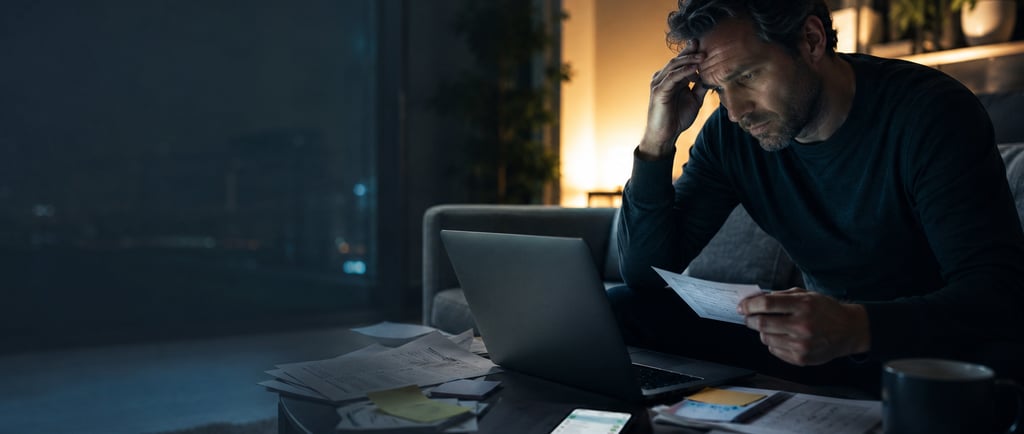
Another person is sitting in front of a screen. On the coffee table by the couch sits a cold cup of coffee; the television plays in the background, talking to an empty room. A phone rests nearby, next to a few scattered papers that have been shuffled around for days—as if changing their position could create the illusion of productivity. The day is practically over, and the quietness of the evening has already begun its work, slowing the pace, softening thoughts, and drifting the mind toward something lighter.
Then, suddenly, the phone vibrates.
It is an automatic gesture, one we repeat dozens of times a day without even registering it. Glancing at the screen for a fraction of a second, the eyes look away, snap back a second time, and immediately a third.
“Oh damn…”
It is incredible how quickly the atmosphere of a room can shift. Just seconds before, that couch represented comfort and the end of the working day; now it feels restrictive, suddenly uncomfortable. An email read days ago resurfaces alongside an unfinished document, a postponed phone call, or a reply delayed because "there was still plenty of time."
The brain then performs a curious operation. In a matter of seconds, it gathers every loose end scattered over the previous days and forces them into a single point.
Now, the clock in the corner of the screen is no longer just a number. It is a countdown.
The Cost of Admitting Vulnerability
And this is likely where we begin telling ourselves one of the most reassuring stories a human being can invent: that the problem does not exist, that it is too small to matter, or that it is someone else's responsibility. Admitting a vulnerability carries an uncomfortable psychological cost because it forces us to acknowledge that we do not have absolute control.
This psychological mechanism constantly changes its outfit. There are those who bypass security measures, convinced they are immune to risks; those who postpone a document because they fear it won't be good enough; those who avoid auditing a warehouse because they dread finding anomalies; or those who delay a medical check-up because, as long as there is no official diagnosis, the problem remains suspended in a strangely comforting limbo.
As long as we avoid looking at reality, a part of the brain continues to behave as though the danger does not truly exist.
It is precisely here that security, planning, organization, and everyday life suddenly stop looking like separate worlds and begin speaking the same language.
Decoding the Language of Error
Up to this point, however, it is the language of error. It is the universal code of delayed reaction, where human beings—whether dealing with a cybersecurity flaw, a stack of overdue documents, or a medical diagnosis—only act once the problem has already exploded, driven by anxiety rather than control.
To escape this trap, we must learn a different language: that of prevention and method. In the end, almost everything should work according to a remarkably similar logic: first you anticipate what could happen, then you gather information, observe it, analyze it, make a decision, apply it, evaluate the results, and start the cycle all over again. It is a continuous loop, almost boring in its predictability, and precisely for that reason often ignored. The human brain has a strange attraction to the spectacular, while it consistently underestimates the slow, methodical, and ordinary.
Confusing Agitation with Control
Fear, on the other hand, operates in a completely different way. It is fast, sudden, and aggressive. It starts the engines, accelerates the heartbeat, and forces us into motion, highlighting details we completely ignored just moments before. It is the exact same force that drives someone to desperately request a bug sweep after months of overlooked warning signs; the same force that turns a forgotten email into a sleepless night, or pushes someone to secure their home only after a burglary happens down the street. Certain problems simply do not wait for our convenience before demanding attention.
At this exact juncture, we commit our most common and dangerous mistake: confusing agitation with control.
This illusion manifests in two distinct yet equally hazardous ways. On one hand, in ordinary workflow, rushing at the last minute yields a false, almost exhilarating sensation of being active, focused, and capable of performing under pressure. On the other hand, when dealing with actual security threats—be it a physical break-in or a technical surveillance breach—that same rush loses all trace of gratification. It becomes pure panic, a blind and desperate hyperactivity where we make frantic calls, demand immediate answers, and scramble for data just to raise a shield after the blow has already landed. Yet, in both scenarios, movement does not equal control; more often, it simply proves that something has forced us to move.
The difference is subtle, but vast.
Those who build systems act before the situation explodes.
Those who chase fear only move once the threat becomes impossible to ignore.
The Emergency Medicine of Security
This pattern repeats itself everywhere. It appears in security, where people only care about vulnerabilities after reality hits them in the face; it emerges at work, where we prefer to comfort ourselves with the illusion that “there is still time” just to avoid the friction of starting; it even shows up in personal relationships, where crucial conversations are postponed for weeks simply because admitting something is broken is too uncomfortable.
As long as we deny a vulnerability, we can keep telling ourselves that we master our own destiny. The moment we choose to look it in the eye, we are forced to accept a far more unsettling truth: threats exist regardless of our willingness to think about them.
This is exactly why security is so often treated like emergency medicine. People seek it out when the fever strikes, when anxiety bites, and when danger stops being theoretical and suddenly becomes concrete, real, and close.
A bug sweep when suspicion turns to dread.
A security camera after a burglary.
A protocol after an accident has occurred.
A plan after the chaos.
But reality has an incredibly frustrating trait: it does not wait for us to start worrying about it.
Threats continue to brew beneath the surface. Vulnerabilities remain wide open even while we look the other way. Time keeps moving forward, entirely indifferent to our endless “I’ll start tomorrow.”
In the end, perhaps the most uncomfortable question is not whether the critical moment will arrive.
The real question is this: are we building a system... or are we simply waiting until the water reaches our throats?